
by Paula Johnson
Were you one of those students who never seemed to have correct punctuation on your papers? Too many commas, not enough commas? When to use a period and when to use a semicolon? Why bother with a semicolon if a period does the same job?
Even though I was not “highly qualified” to teach English once I started teaching in Michigan, I did have thousands of history research papers to correct. And as a student who was drilled (think nuns in habits wearing large rosaries) in English grammar and usage, I would cringe as I read the reports.
Not only did I have to contend with mistaken history, but to wade through misspellings, run-on sentences and lack of correct capitalization made my body weak. Of course, the plagiarized parts were copied beautifully.
So, when John sent me an article 19 Punctuation Marks You Never Knew You Needed, he had my attention. John and I went through the same school system and had many of the same teachers, except for the time I pleaded his case to our dad for John to attend public school to avoid what could have been jail time. He had a two-year reprieve at Churchill Jr. High.
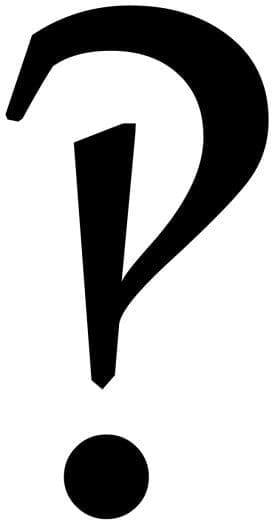
A couple of marks that I never heard of but can see a reason for their usage – at least from a high schooler’s point of view – are the Exclamation comma and the Question comma (instead of the point below the exclamation and question, place a comma). This way you can insert more drama midway into the sentence.
Today’s dagger (†), which can be used in place of an asterisk (*), evolved from a lemniscus (÷) and the 7th century obelus (—), a long dash. This mark was called The Arrow by Isidore of Seville, a grammarian from the 6th and 7th centuries. Saint Isidore was named the patron saint of the Internet in 1997, in case you are looking for intercession the next time you are having trouble on the Internet.
Besides the lemniscus, another mathematical symbol was also a punctuation mark. The “greater than” symbol (>) in English grammar is called a diple. A diple is used to indicate a passage which is supposed to be of particular interest – at least by the writer.
One historical punctuation mark that I used frequency in correcting reports was the pilcrow (¶). Not only would some students create run-on sentences because they did not know when or how to create the end of a sentence, but they had a similar problem with paragraphing. The pilcrow is used to indicate that a new paragraph should begin here.
In 1580 the irony mark was introduced. It had a very short shelf life, however. Maybe part of the problem was the irony mark looks like the psi symbol (Ψ) with a period below it. Or maybe it did not last long because most people don’t understand irony.
In case some of you older folks are confused about the # symbol, let me help you. In the beginning, lb was the abbreviation for the word pound. Then typesetters began connecting the two letters with a bar (-) through them above the bulb in the “b.”
So early recipes would use lb for pound. Then the typesetter’s version got changed to #, and that symbol would appear, as in 2# hamburger.
This symbol is also used as a number sign, as in “Do you want door #2 or door #3?” It is now also used as a hashtag on Twitter with key words or phrases, as in #bitsandpieces – if I even had a Twitter account or cared!
In the 1960s the # symbol got a unifying name: octothorpe. When the telecommunications industry put # on the phone, they named it the octothorpe. Interestingly enough, though, whenever you are asked to press it, it is called a pound sign not an octothorpe.
English is such a difficult language to master. No matter whether it is punctuation, grammar, or usage, it is always changing. Maybe the interrobang is the best way to end it all…. ‽ … a combo of the question mark and exclamation point. That is in case you want to present a question and be emphatic about it.

Leave a Reply
You must be logged in to post a comment.