
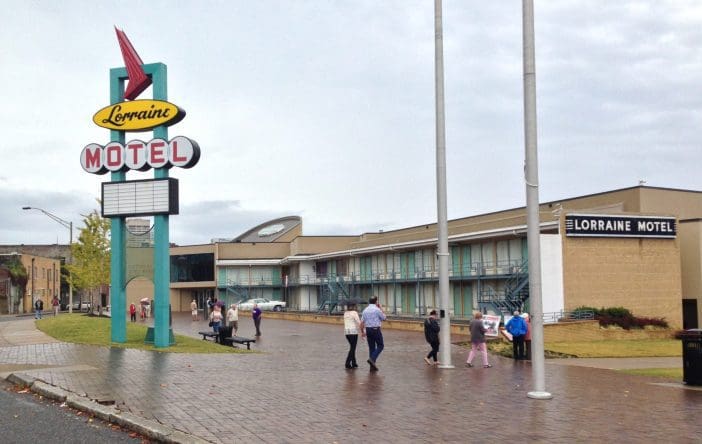
The courtyard of the National Civil Rights Museum, Memphis.
Test your memory!
In February 10’s Bits & Pieces on page three of The News by columnist Paula Johnson, we test your knowledge of little-known facts or facts you may have forgotten. To expand on that theme, The News is including a Black History Month pictorial quiz.
This is not only to honor the achievements and recognize the struggles of African Americans, but to encourage lovers of travel to visit the National Civil Rights Museum, Memphis. The Museum was established in 1991 at the former Lorraine Motel. For readers of a certain age, the name will be easily recognized as the site where Dr. Martin Luther King Jr was assassinated on April 4, 1968. Words are inadequate to describe the experience.
According to the Museum’s website, civilrightsmuseum.org, When it comes to civil rights, it’s important not only to learn about historical milestones but also to interpret them in a way than can be applied to today’s challenges. Through multi-sensory and multi-media innovations, historical artifacts and structures, events, speakers and online resources, the National Civil Rights Museum champions educational programming and offers visitors a full immersion experience.
May your memory serve you well on the quiz. If not, may it pique your interest to research our subjects.
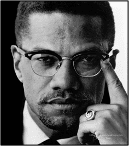
1. This man once lived in Lansing MI and grew to challenge the mainstream civil rights movement and the nonviolent pursuit of integration championed by Martin Luther King Jr. He told his followers to use “any means necessary” against white aggression. His views evolved after embracing the Islam faith and he came to adopt more nonviolent means of expression. His bestselling biography laid the foundation of the Black Power movement in the late 1960s and ‘70s.
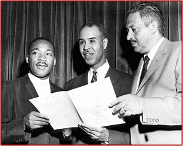
2. The man in the middle of the photo at right was a prominent civil rights activist in the United States from the 1930s to 1970s. When W.E.B. DuBois left the NAACP in 1934, he became the editor of Crisis, the organization’s official magazine. The man at the far right in the photo was the grandson of a slave and became the first African American justice of the Supreme Court. As counsel to the NAACP, he won the Brown v. Board of Education case in 1954, which ended racial segregation in public schools.
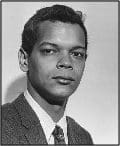
3. The man at left was elected to Georgia’s state legislature in 1965. His opposition to the Vietnam war meant that it would take a US Supreme Court ruling for him to be allowed to take his seat. As a student, he became a founding member of the Committee on Appeal for Human Rights and later helped form the Student Nonviolent Coordinating Committee in 1960. He led nonviolent student protests against segregation in Atlanta parks restaurants and movie theaters.
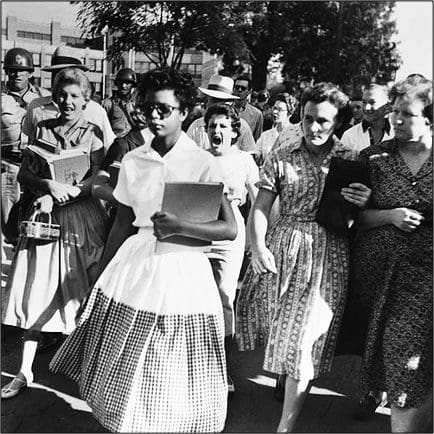
4. The young African American student being taunted by white students at right is one of The Little Rock Nine who, in 1957, were the first black students to ever attend the all-white Little Rock Central High School in Little Rock, Arkansas. The school was integrated as a result of Brown v. Board of Edcuation, a legal case that ended racial segregation in public schools. The famous photo at right was taken by Johnny Jenkins of United Preess.
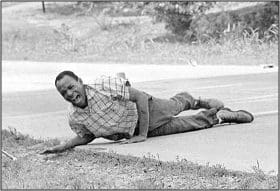
5. The wounded civil rights activist at left was the first African American to attend the University of Mississippi in 1962. He was shot by a sniper on June 6, 1966, shortly after beginning a lone civil rights march through the South known as the March Against Fear. He had been walking from Memphis to Jackson, Mississippi, to encourage voter registration.
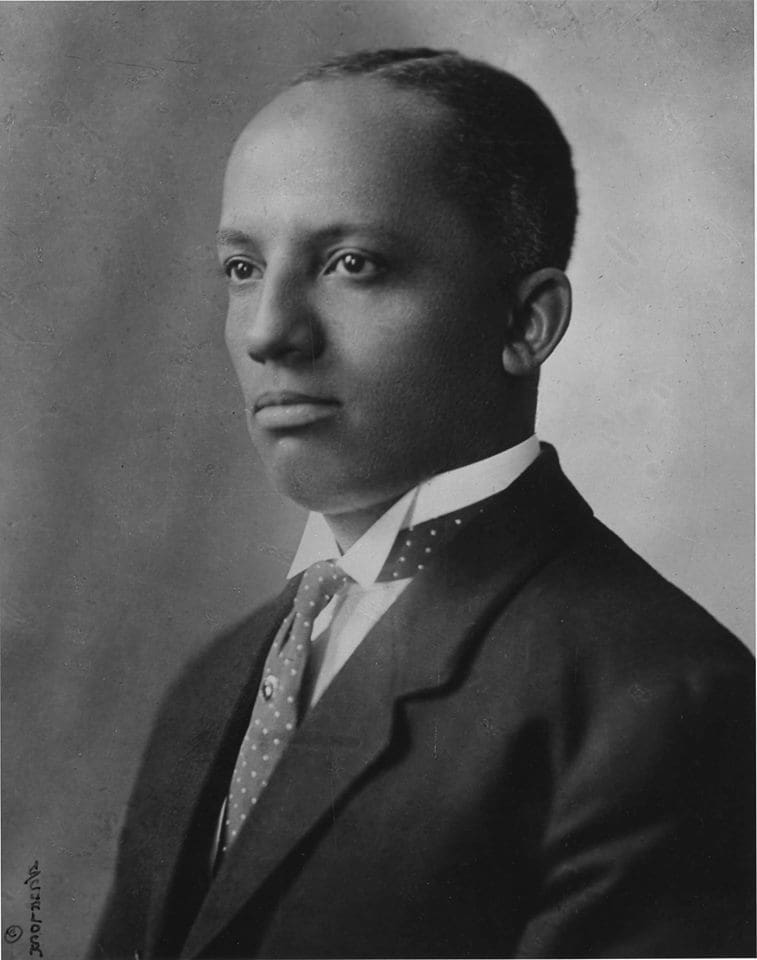
6. The gentleman at right can rightly be called the “Father” of Black History Month. The graduate of the University of Chicago established the Journal of Negro History in 1916, helped create Negro History and Literature Week in 1924, which was later named Negro History Week. The annual event expanded to a Black History Month in 1976.
How do you think you did?
The Answers
1. Malcolm X began life as Malcolm Little on May 19, 1929, in Omaha Nebraska. Recommended biography: Malcom X: A Life of Reinvention by Manning Marable
2. The man in the middle of the photo is Roy Wilkins a prominent civil rights activist and member of the NAACP. To his left is Justice Thurgood Marshall who served for 24 years on the Supreme Court. Recommended books: Roy Wilkins: The Quiet Revolutionary and the NAACP by Yvonne Ryan and Thurgood Marshall: American Revolutionary by Juan Williams.
3. Julian Bond. Bond served as the head of the Southern Poverty Law Center and NAACP. He left Morehouse College to become the communications director for the Student Nonviolent Coordinating Committee. Recommended book: Julian Bond’s Time to Teach: A History of the Southern Civil Rights Movement
4. Elizabeth Eckford, who at 15, faced an angry mob of segregationists as the first member of the Little Rock Nine to arrive at school. Recommended book: The Worst First Day: Bullied While Desegregating Little Rock Central High by Elizabeth Eckford. (Winner of the 2018 Moonbeam Multicultural Non-Fiction Gold Children’s Book Award)
5. James Meredith, the first black student to enroll at the University of Mississippi. He was shot by a sniper in 1966 during the first day of the March Against Fear. While he went to the hospital, other civil rights leaders, including Martin Luther King Jr and Stokely Carmichael, marched on his behalf. Recommended book: An American Insurrection: James Meredith and the Battle of Oxford, Mississippi, 1962 by William Doyle.
6. Carter G. Woodson, historian, author, journalist, and the founder of the Association for the Study of African American Life and History. His dedication to celebrating the history and achievements of African Americans led to the establishment of Black History Month. Recommended book: Carter G. Woodson: A Life in Black History by Jacqueline Goggin.

Leave a Reply
You must be logged in to post a comment.