
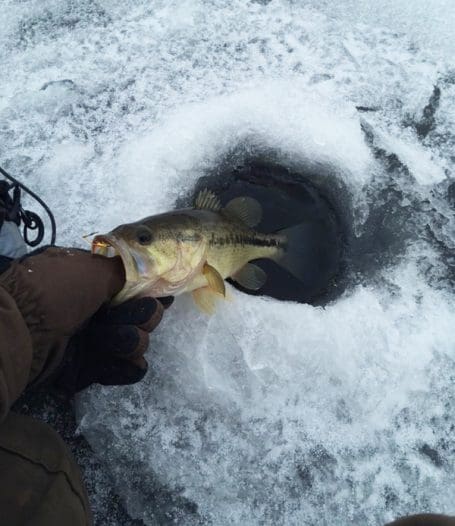
What every angler hopes to see in winter – good ice.
According to Pure Michigan (https://www.michigan.org/ice-fishing), When the weather in Michigan gets colder, anglers get fishing across more than 11,000 inland lakes and tens of thousands of miles of rivers and streams. In fact, for many anglers, winter is the best time to get hooked
Winter can also be a good time to practice patience. . .
by Thomas Puleo
I’m stuck in the season in between. The season in between usually begins somewhere in the vicinity of Thanksgiving – give or take a week – and can stretch well into January.
This span of time encompasses the gap between the end of boating season and beginning of ice fishing season to complicate matters pertaining to planning and patience. The end of one season and beginning of the other are moving targets and unpredictable in any given year.
The season in between covers a relatively brief time on the calendar; however, this time seems to travel at the pace of snails or molasses in January. Yes, yes. I realize snails and molasses might be cliché depictions of the type of slow I speak of – but cliché or not – they’re both accurate.
Remember sitting in school staring at the clock and sometimes you’d swear it was going backwards? That kind of slow.
Watching paint dry is an action sport compared to watching ice form on a lake.
It can take a while.
Although there are fits of cold that shoulder the official three months of winter, it is the true bitterness of January and February that warms the hearts of those with ice augers ready at hand.
“We’re making ice” is what we want to hear, and as the weather cools, these three words start to ripple across the region quietly passed among the ice fishing faithful.
This is an encouraging period of time as the first arctic blasts of December dip the mercury into single digits.
“We’re making ice” is a big step towards the end of the season in between.
It is during these early winter storms that some lakes, the shallow ones, will indeed ice up. At this point, some fishermen – having lost the battle of patience – venture out onto this thin early ice. Inevitably, someone gets ice cold and wet – at best.
So, “we’re making ice” is encouraging; however, what one really wants to hear is “we are making GOOD ice.” Ah, good ice. There is a distinct difference. Good ice will be here to stay. Good ice will remain until March. Good ice is still somewhere out there in an extended forecast.
As it so often happens, shortly after that first thin ice, the weather will warm, and when combined with rain showers, will wash our ice fishing away.
More waiting.
Tackle preparation has served well as a good use of time during the past few weeks but seeing as how we’ll have some more time; the gear will get another going through and final checklists will be made final again.
Then, it finally happens. Sometime in the second or third week in January, the perpetual grey of midwinter settles upon us. Soon, for those who have endured and resisted the temptation to drive four hours north in search of fishable ice, it will be our turn.
“We’re making good ice!” becomes a greeting to friends who also fish. It becomes an answer to “how’s it goin’?” I’ll hear it all day at work.
Children look forward to Christmas in much the same manner as to our anticipation of good ice.
Conversations surrounding the good ice will be heard at church, the grocery store, most definitely the bait and tackle shops, and my personal favorite locale for fishing’s inside scuttlebutt, the barber shop. You’ll want to search out a barber that is also an avid fisherman. If you can find this, you have found a veritable wealth of information.
If the barber is a fisherman, his clientele will undoubtedly be comprised of like-minded sports who will share with him endless yarns on subjects pertaining to the local fishing scene. Careful not to speak of anything too revealing at the bait shop, with the barber, they feel safe.
Make your appointments for once a week in-season and you’ll gather more fishing info than at church, the grocery store, and the bait shop combined. Closely akin to guarding your favorite fishing hole with your life – do not let loose the name and location of your barber.
With the lakes now capped off with good fishable ice, the season in between comes to a close. The first trips begin.
Adjusting to the simple tasks on the ice seems awkward after being ten months out of practice, but soon enough it becomes natural again.

Holes are drilled, fish are caught, all is right with the world. Thanksgiving is a distant memory.
The good ice will stick around for quite a while, most likely until mid-March. It’s time to settle in. For the next few weeks my life will revolve around an eight-inch hole bore into the surface of a lake, a portal to another world.
It is the wonder and unknown of any new fishing day that keeps my attention new, even after decades of new fishing days.
If we knew how the day would turn out beforehand, there would be very little excitement in the already known. To this end, each baited offering lowered with hope through the icy window becomes an invitation to wonder.
There will be great days and not-so-great days, average to mediocre days, big fish days, and many fish days. Of course, there will be a few fishless days sprinkled in to keep wonder alive.
As the ice season is set to begin, I extend to all members of the auger brigade the well wishes of a safe and bountiful 2023 ice fishing season.
Be safe out there, wear flotation, carry ice picks, always spud the ice before you step and take a buddy along whenever you can. Good luck to all!
***
Ice Safety Tips from the DNR
• Your safety is your responsibility! There is not a reliable “inch-thickness” to determine if ice is safe.
• You can test ice thickness and quality using a spud, needle bar or auger.
• Strongest ice: clear with bluish tint.
• Weak ice: ice formed by melted and refrozen snow. Appears milky.
• Stay off ice with slush on top. Slush ice is only half as strong as clear ice and indicates the ice is not freezing from the bottom.
• A sudden cold front with low temperatures can create cracks within a half-day.
• A warm spell may take several days to weaken ice, and cause the ice to thaw during the day and refreeze at night.
• Ice weakens with age.
• If there’s ice on the lake but water around the shoreline, be extra cautious.
• Stronger the current on the lake, the more likely the ice will give to open water.
• Avoid areas of ice with protruding debris like logs or brush.
• Keep an eye out for dock bubblers or de-icers as the ice near these mechanisms will be unsafe. Always check the ice and be aware of your surroundings.


Leave a Reply
You must be logged in to post a comment.