

How do they do it? ……… The birds that is!
by John Mooy
The wind was howling outside and when I got up out of bed, it was still howling. The snow was hitting against the bay window and the branches on the trees were in full and continual motion. So, I did what I always do first thing in the morning, I lit several candles, brewed some coffee, and sat down in the comfortable chair near the window and began my usual early morning gaze out the window. Gray and cold with a fog hanging over the lake let me know that I was glad to be seated in the house with coffee in hand.
Then I noticed coming through the haze was a group of seagulls just riding on the currents of the wind. They almost looked to be playing as they glided in circles not far offshore. I was hoping to see one of the eagles who often make morning appearances, as well, but not this morning. With it being so cold out, I began wondering about the birds. Are they cold? If so, what do they do to keep warm? The mere act of flying helps to keep them warm. But there are other fascinating adaptations that birds make in order to acclimate themselves to the cold weather.
Birds during cold weather often seek shelter in the crevices of tree and holes in trees that may have been used by other animals who no longer occupy the space. Some of the smaller birds we’re familiar with, who don’t head south (migrate) for warmer weather, we have noticed on the coldest of winter days. Often, they appear to be a bit larger in size than usual. They have fluffed up their feathers to allow themselves to trap air between their feathers. This would be somewhat like our attempts to put on some loose-fitting garments in winter to trap the air and provide warmth.
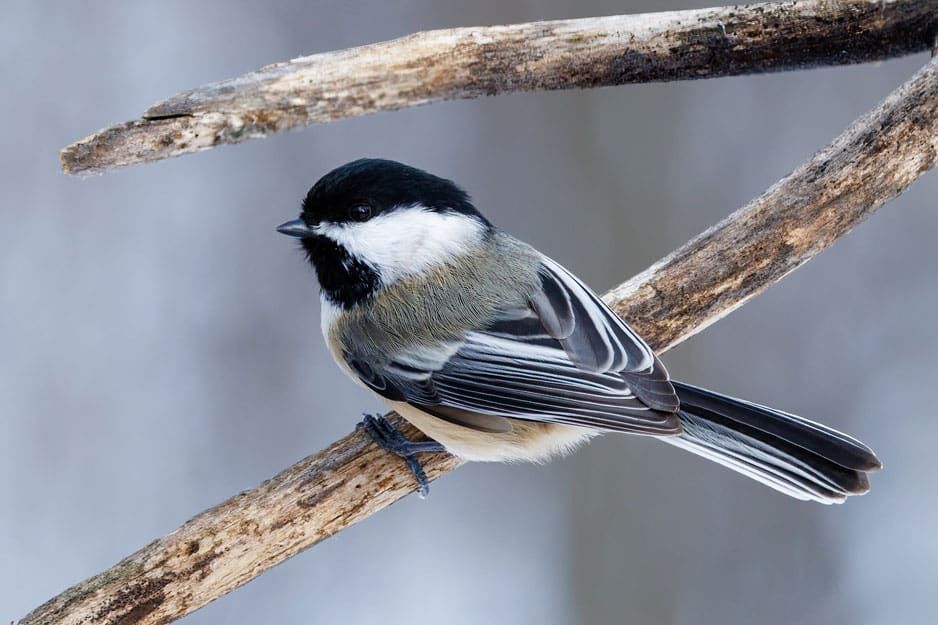
The tiny feet of small birds such as a chickadee have a very unusual adaptation. The bird can constrict the amount of blood flowing through vessels into their feet and reduce the temperature of their feet. They can reduce the temperature almost to the point of freezing but remain just above that temperature. With their feet being a bit colder, less energy is taken away from the body to warm the feet. I’m sure all of us have observed a bird during the coldest weather sitting on the branch of a tree, fluffed up with its feathers covering its feet.
Black-capped Chickadee
Poecile atricapillus
In winter Black-capped Chickadees eat about half seeds, berries, and other plant matter, and half animal food (insects, spiders, suet, and sometimes fat and bits of meat from frozen carcasses).
Believe it or not, shivering is designed to help a bird generate body heat. There are times they will be perched on a tree branch and shiver most of the night. Again, they do this by design.
What I have found to be intriguing is the small birds’ ability to control their body temperature. If we use the chickadee for example, they can make their temperature vary by as much as fifteen degrees. The closer the bird comes to matching its own body temperature to the outdoor temperature the less heat they have to generate to warm their own body. Rather amazing.
So, when you see birds out in the cold, know that they have the capability through adaptation to stay warm. They won’t mind however if you take the time to put out some seeds for them to eat. While they are great scavengers, and in some cases “store” food, we can still be of help.
So now that you may know just a bit more about our feathered friends make sure to enjoy the beauty they provide for us just by being themselves.
Have a great week, Marcellus.
You’re the best.
And given the fact that chickadees eat twenty times as much in winter as they do in summer, they weigh just one half of an ounce.
In case you’re wondering:
A bird’s eyes take up 50% of their heads.
Birds are descended from the theropod dinosaur.
Birds don’t have teeth.
The hooded pitohui is the only poisonous bird in existence.
Some ducks sleep with one eye open.
The goose was the first bird to be domesticated by humans.

Leave a Reply
You must be logged in to post a comment.