

SECTION 1. Purpose
A. An Ordinance to implement the provisions of the Michigan Regulation and Taxation of Marihuana Act (MRTMA), MCL 333.27951 et seq. By requiring a Permit and compliance with requirements as provided in this Ordinance, in order to maintain the public health safety and general welfare of the community at large; retain the character of neighborhoods; and mitigate potential impacts on surrounding properties and persons.
B. Nothing in this ordinance is intended to grant immunity from prosecution, penalty or sanction for cultivation, manufacture, possession, use, sale, or distribution of marihuana, in any form that is not in compliance with the Michigan Medical Marihuana Act, initiated Law I of 2008, MCL 333.26421 et seq.; the Medical Marihuana Facilities Licensing Act, MCL 333.27101 et seq.; the Marihuana
Tracking Act, MCL 333.27901 et seq.; Michigan Regulation and Taxation of Marihuana Act, MCL 333.27951 et seq.; and applicable rules promulgated by the State of Michigan.
C. As of the effective date of this ordinance, marihuana remains classified as a Schedule I controlled substance under the Federal Controlled Substances Act, 21U.S.C. Sec. 801 et seq., which makes it unlawful to manufacture, distribute, or dispense marijuana. Nothing in this ordinance is intended to grant immunity from any criminal federal laws.
SECTION 2. Definitions
For the purpose of this ordinance:
A. Any term defined by the Michigan Medical Marihuana Act, MCL 333.26421 et seq., shall have the definition given in the Michigan Medical Marihuana Act.
B. Any term defined by the Medical Marihuana Facilities Licensing Act, MCL 333.27101 et seq., shall have the definition given in the Medical Marihuana Facilities Licensing Act.
C. Any term defined by the Marihuana Tracking Act, MCL 333.27901 et seq., shall have the definition given in the Tracking Act.
D. Any term defined by the Michigan Regulation and Taxation of Marihuana Act, MCL 333.27951 et seq., shall have the definition given in the Michigan Regulation and Taxation of Marihuana Act.
E. “Marihuana grower” means a person licensed to cultivate marihuana and sell or otherwise transfer marihuana to marihuana establishments.
“Marijuana” or “marihuana” means that term as defined in the Public Health Code, MCL 333.1 101 et seq.; the Michigan Medical Marihuana Act, MCL 333.26421 et seq.; the Medical Marihuana Facilities Licensing Act, MCL 333.27101 et seq.; the Marihuana Tracking Act, MCL 333.27901 et seq.; and the Michigan Regulation and Taxation of Marihuana Act, MCL 333.27951 et seq.
G. “Marihuana establishment” means a marihuana grower, marihuana safety compliance establishment, marihuana processor, marihuana microbusiness, marihuana retailer, or provisioning center, marihuana secure transporter, marihuana and designated consumption establishment, or any other type of marihuana-related business licensed by the department.
H. “Permit” means a current and valid Permit for a commercial Adult Use Marihuana Establishment issued under this Ordinance, which shall be granted to a Permittee only for and limited to a specific Permitted Premises and a permitted Property.
I. “Permittee” means a person holding a TOWNSHIP OF PORTER operating Permit issued under the provision of this Ordinance.
“Permitted Premises” means the particular building or buildings within which the Permittee will be authorized to conduct the Establishment’s activities pursuant to the Permit.
K. “Permitted Property” means the real property comprised of a lot, parcel or other designated unit of real property upon which the Permitted Premises is situated.
L. “Person” means an individual, corporation, limited liability Company, partnership, limited liability partnership, limited liability limited partnership, or other legal entity.
M. “Marihuana microbusiness” means a person licensed to cultivate not more than 150 plants, to transfer marihuana to a marihuana safety compliance establishment, to sell or otherwise transfer marihuana to individuals 21 years of age or older and marihuana consumption establishment.
N. “Marihuana processor” means a person licensed to obtain marihuana from marihuana establishments; process and package marihuana; and sell or otherwise transfer marihuana to marihuana establishments.
O. “Marihuana retailer” means a person licensed to obtain marihuana from marihuana establishments and to sell or otherwise transfer marihuana to marihuana establishments and to individuals who are 21 years of age or older.
“Marihuana safety compliance establishment” means a person licensed to test marihuana, including certification for potency and the presence of contaminants.
Q. “Marihuana secure transporter” means a person licensed to obtain marihuana from marihuana establishments in order to transport marihuana to marihuana establishments.
R. “Co-location” means the aggregation of multiple license types or entities, or additional licenses of the same type, permitted under the MRTMA and located on one or more lot of record owned by an existing MRTMA licensee, approved for operation in the TOWNSHIP OF PORTER.
S. “License” means one or more stacked licenses of any of the Establishment Types allowable under the MRTMA. Each MRTMA allowable establishment type and stacked Class C Grower or Excess Grower license shall be deemed a separate license with a separate permitting fee.
“Licensee” means the entity currently licensed by the State of Michigan under
MMFLA applying to the TOWNSHIP OF PORTER for any of the Establishment Types allowable under the MRTMA
U. “Stakeholder” means any person or entity holding an ownership interest in a License or Permittee.
“Security Plan” means a plan for preventing unauthorized access to, or theft pilferage from an MRTMA licensed establishment, approved for operation in the TOWNSHIP OF PORTER. The plan is subject to review and reasonable approval by the TOWNSHIP Board, but shall include at a minimum the following components:
(l) A Perimeter security for all establishments except the marihuana retailer;
(2) an exterior lighting system;
(3) a building security system;
(4) On-site security cameras;
(5) An off-site official contact list;
(6) Established hours of operation;
(7) Appropriate signage;
(8) An affirmation to allow inspection by the Michigan Cannabis Regulatory Agency (CRA), Law Enforcement Officers or a representative of the TOWNSHIP OF PORTER;
(9) Such other conditions as may be suitable for the particular license, or establishment to be operated by the MRTMA licensee.
SECTION 3. Authorization of Establishments and Fee A. The maximum number of each type of marihuana establishment allowed in the TOWNSHIP OF PORTER shall be as follows:
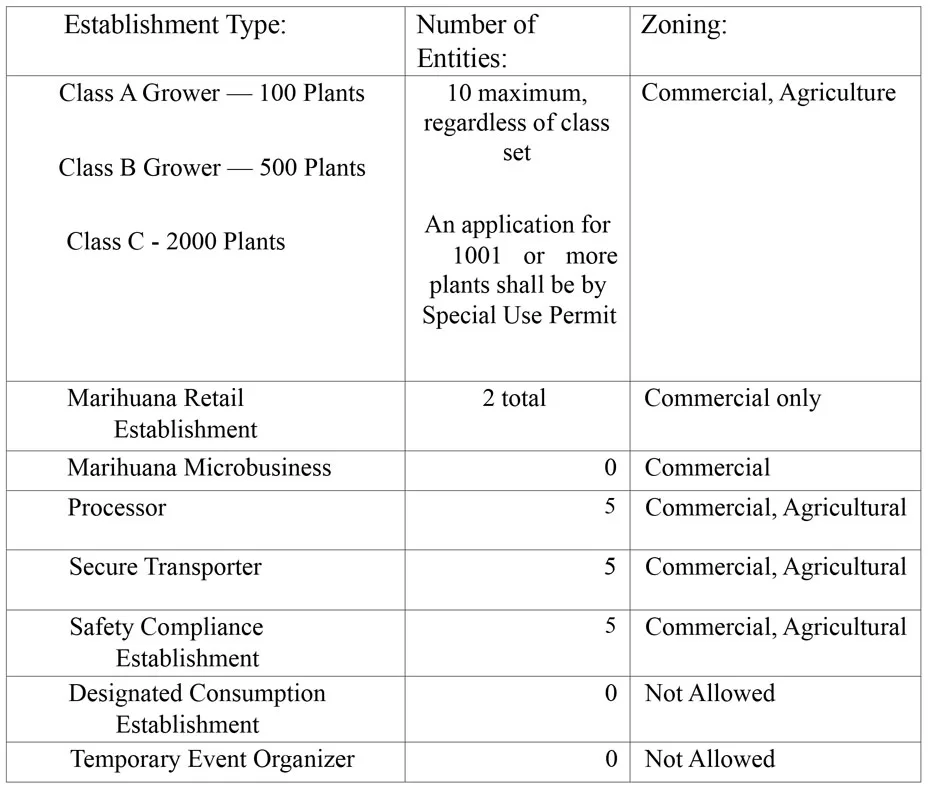
B. PORTER TOWNSHIP Board may review and amend the maximum number of each type of marihuana establishment allowed at their discretion and determine whether this maximum should be changed. The review and its findings shall be recorded in the minutes of the relevant meeting of the TOWNSHIP Board.
C. A nonrefundable fee shall be paid by each marihuana license permitted under this ordinance in an annual amount of not more than $5,000.00 per license as set by resolution of the TOWNSHIP OF PORTER. Should a permitted establishment not
be MRTMA state licensed and in operation one year after TOWNSHIP OF PORTER permitting, that license shall not be eligible for renewal. Once permitted, Applicant may stack no more than two (2) additional Grower licenses without further approval provided, however, that Applicant has paid the Township permitting fee for each additional stacked license.
SECTION 4. Requirements and Procedure for Issuing Permits
A. No person shall operate a marihuana establishment in the TOWNSHIP OF PORTER without a valid marihuana establishment permit issued by the TOWNSHIP OF PORTER pursuant to the provisions of this ordinance. Upon the expiration of an existing Permit, a permit will be automatically renewed by the TOWNSHIP OF PORTER for one (1) year if:
(1) there are no uncured administrative and/or legal violations in the prior year, including no taxes owed;
(2) the applicant has paid the annual permit fee for the renewal period;
(3) any stakeholder or investor change has been fully disclosed to the TOWNSHIP OF PORTER;
(4) the applicant has paid and received renewal of its state license, and
(5) provide name of banking institution used by Licensee.
B. On and after adoption of this ordinance the Township shall accept applications for authorizations to operate a marihuana establishment within the Township. Applicant shall furnish a current MRTMA state prequalification approval letter. The Application shall be made on the approved Township Form and must be submitted to the Township Clerk or township approved designee. An application is not considered “complete” until it complies by meeting all the material provisions of Section 4(C)(l—15) and includes an application fee in the amount of the annual marihuana license fee. Once the Clerk or designee determines, in his or her sole discretion the Application is determined to be “complete” in its material parts, and the Township has received the appropriate fee, the Application shall be time and date stamped. If the limit on the number of authorized establishment type has been reached, the Complete Application shall be held by the Township Clerk or township approved designee, in consecutive time and date stamped order for future processing upon the opening of additional establishments.
Once applications are verified complete, the Township Clerk or township approved designee shall forward the Complete Applications to the Township Zoning Administrator. If the application is for 1001 or more plants, the Township Planning Commission shall hold a Public hearing for site plan review and to give the public the information regarding the proposed application. The Application shall be reviewed and acted upon in accordance with priority by filing date and time and a recommendation provided to the Township Board.
C. An application for a Permit required by this Ordinance shall contain the following:
l. The appropriate non-refundable permit application fee in the amount determined by the TOWNSHIP.
2. If the applicant is an individual, the applicant’s name, physical address including residential and any business address(s), attached to the individual, copy of government issued photo identification, email address, and one or more phone numbers including emergency contact information, and if applicable Federal EIN;
3. The name and address of the proposed establishment and the name, address, phone number and email address for the proposed individual Permittee.
4. One of the following: (a) proof of ownership of the entire premises wherein the Establishment is to be operated; or (b) written consent from the property owner for use of the premises in a manner requiring a permit under this Ordinance along with a copy of the lease for the premises;
5. Prior to final approval, proof of an adequate premise liability and casualty insurance policy in the minimum amount of the requirements addressed in the Michigan Regulation and Taxation of Marihuana Act as amended or applicable State Laws, covering the Establishment and naming the TOWNSHIP as additional insured party, for the payment of any damages arising out of an act of omission of the applicant or its stakeholders, agents, employees, or subcontractors;
6. A description of the security plan for the Establishment, including, but not limited to, any lighting, alarms barriers, recording/monitoring devises, and/or security guard arrangements proposed for the establishment and premises.
7. A floor plan of the Adult Use Marihuana Establishment, as well as a scale diagram illustrating the property upon which the Establishment is to be operated, including all available parking spaces, and specifying which parking spaces, if any, are handicapped-accessible, and the location of the Material Safety Data sheets and any chemical storage;
8. A list of any MSDS being stored on the premises, including safety sheets;
9. An affidavit that the applicant has paid all property taxes, special assessments, fines, fee or other financial obligations to the TOWNSHIP;
10. An affidavit that the transfer of Marihuana to and from Establishments shall be in compliance with the MRTMA and applicable state laws;
11. Any proposed text, signs or graphical materials to be shown on the exterior of the proposed Establishment;
12. A location area map of the Establishment and surrounding area that identifies the relative locations and distances [closest property line to the subject Establishment(s)] to the closest real property comprising a public or private elementary, vocational or secondary school; libraries, churches, place of worship, public parks and State licensed child care facilities. A establishment shall not be within 1,000 feet of a pre-existing public or private school providing education in kindergarten or any of grades I through 12. The measure is from the building (school, church, etc.,) to the establishment. Not boundary line to boundary line. The Establishment Plans shall state conformity characteristics including setbacks from all occupied dwellings in the surrounding area where the Establishment will be located.
13. An affidavit that all operations will be conducted in conformance with State law 14. A chemical and pesticide storage plan that states the names of chemicals and pesticides to be used in the Grower and where and how the pesticides and other.
chemicals will be stored in the establishment, along with plan for disposal of unused pesticides and chemicals;
15. The following additional items and site plan shall be required:
(a) Name and address of property owner, including the names and addresses of any officers of a corporation, or partners of a partnership, including documentation of ownership.
(b) Legal description of the property with tax identification number(s).
(c) The area of the subject parcel stated in acres or, if less than one acre, in square feet.
(d) The present zoning classification of the subject parcel.
(e) A general description of the proposed use.
(f) A vicinity map showing the location of the site in relation to the surrounding street system and indicating adjacent parcels with their existing use.
(g) Recent aerial photograph showing the site and adjoining parcels.
(h) Documentation of preliminary approvals, as applicable, which may include, but may not be limited to the following:
a. Van Buren County Road Commission (for property adjacent to county roads).
b. Michigan State Highway Department (for property adjacent to state highways).
c. Michigan Department of Environmental Quality (for development of a wetland and environmental permits).
d. Van Buren County Drain Commission (for development over I acre and/or within 500 feet of a lake, stream, or county drain).
A map prepared to a scale of not less than one inch (l “) equals fifty feet (501) with a graph scale, north arrow, and in sufficient detail so that the reviewing body can readily interpret the site plan, and including the following features:
a. Name and address of the preparer.
b. Date prepared (including revisions).
c. Property boundaries.
d. Topography, both existing and proposed at five feet contour intervals, and its relationship to adjoining land. (Arrows should indicate direction of drainage.)
e. Natural features, such as woodlots, marshlands, streams, ponds, lakes, drain basins, and similar features. Indicate trees that are greater than 2” in diameter and which features are to be retained and which are to be removed or altered.
f. Existing man-made features, such as roads and structures.
g. Location and address of existing and proposed buildings or structures on the site, indicating the height, size, and construction type of each.
h. Building setback of front, side and rear yards for existing and proposed buildings.
i. Minimum spacing between existing and proposed buildings on the site.
j. First floor elevation of existing and proposed buildings.
k. Existing and proposed grade elevation at all property corners,
l. Percentage of land covered by buildings and percentage covered by pavement.
m. Percentage of land reserved for open space.
n. Public or private rights-of-way or easements, existing and proposed.
o. Proposed drive locations, width and approach type.
p. Existing and proposed driving lanes, and traffic patterns, if applicable.
q. Existing and proposed parking and loading areas, including size and number of parking spaces.
r. Existing and proposed fire lanes and accessibility for emergency and firefighting equipment.
s. Location of existing and proposed refuse disposal storage area and enclosure details.
t. The size and location of all existing and proposed public and private utilities, including stormwater drainage, sewer treatment systems and water supply.
u. Location of existing and proposed fencing, landscaping, screening, or other buffers required. (Landscaping must be indicated on the site plan or on a separate landscaping plan.)
v. Location, height and direction of on-site illumination. Light fixture details.
w. Location, size, and height of all existing and proposed signs on the site.
x. Location of existing and proposed ground water supply wells, septic systems and other waste water treatment systems.
y. Location of interior and exterior areas to be used for the storage, use, loading/unloading, recycling or disposal of hazardous substances.
z. Location of any existing or planned underground and above ground storage tanks and hazards.
SECTION 5. Permit Renewal
A. An adult use Marihuana establishment permit shall be valid for one year from the date of issuance, unless revoked as provided by law.
B. A valid adult use marihuana establishment permit may be renewed on an annual basis by submitting a renewal application upon a form provided by the Township of Porter and payment of the annual permit fee. Application to renew a marihuana establishment permit shall be filed at least thirty (30) days prior to the date of its expiration.
A permit will be renewed for one (l) year if: l) there are no uncured administrative and/or legal violations in the prior year, including no taxes owed; 2) the applicant has paid the annual permit fee for the renewal period; 3) any stakeholder changes have been fully disclosed to the Township; and 4) the applicant has paid and received renewal of its state license.
SECTION 6. Permit Application Evaluation
A. The TOWNSHIP Zoning Administrator or designee shall assess each application and may make recommendation to the Township Board for approval of the license to the applicant if the applicant has satisfactorily met all requirements.
B. The TOWNSHIP Board shall assess all applications referred to it by the Zoning Administrator or designee.
C. In its application deliberations, the TOWNSHIP Board shall assess each application in each of the following categories:
I. The applicant’s experience in operating other marihuana licensed business.
2. Applicant’s general business management experience.
3. The applicant’s general business reputation.
4. The integrity, moral character, and reputation; personal and business probity; financial ability and experience; and responsibility or means to operate or maintain a Marihuana Establishment.
5. The financial ability of the applicant to purchase and maintain adequate liability and casualty insurance.
6. Whether the applicant or stakeholder has been indicted for, charged with, arrest for, or convicted of, pled guilty or nolo contendere to, forfeited bail concerning, or had expunged any relevant criminal offense under the laws of any jurisdiction, either felony or misdemeanor, not including traffic violations, regardless of whether the offense has been expunged, pardoned, reversed on appeal or otherwise.
SECTION 7. Minimum Operational Standards of an Indoor Grower Establishment
Indoor Grower Establishment shall be allowed in the Township of Porter in Commercial and Agricultural zones. The following minimum standards for an Indoor Grower Establishment shall apply:
A. The indoor grower establishment shall comply at all times and in all circumstances with MRTMA and all applicable regulations, as they may be amended from time to time;
B. The indoor grower must reasonably manage its onsite odor so that no odor shall be detectable outside of any building where marihuana is present. As used in this subsection, building means the building, or portion thereof, used for marihuana production or marihuana processing.
i. The building shall be equipped with an activated carbon filtration system for odor control to ensure that air leaving the building through an exhaust vent first passes through an activated carbon filter.
ii. The filtration system shall consist of one or more fans and activated carbon filters. At a minimum, the fan(s) shall be sized for cubic feet per minute (CFM) equivalent to the volume of the building (length multiplied by width multiplied by height) divided by three. The filter(s) shall be rated for the applicable CFM. iii. The filtration system shall be maintained in working order and shall be in use. The filters shall be changed a minimum of once every six (6) months or as manufacturer recommended.
iv. Appropriate air pressure shall be maintained inside the building to suppress odors or emissions from establishment.
v. Doors and windows shall remain closed, except for the minimum length of time needed to allow people to ingress or egress the building.
vi. An alternative odor control system is permitted if the municipality accepts a report by a mechanical engineer licensed in the State of Michigan demonstrating that the alternative system will control odor as well or better than the activated carbon filtration system otherwise required. The municipality may hire an outside expert at the applicant’s expense, to review the alternative system design and advise as to its comparability and whether in the opinion of the expert it should be accepted.
C. Co-location and stacking of this license shall be limited to three (3) and permitted where the site is using artificial light for nighttime growing period must present a plan to contain all artificial light to the interior space of the establishment (excluding greenhouses).
D. Indoor grower establishments shall reasonably prevent infestation by insects, rodents, birds, or vermin.
E. Lighting shall be regulated as follows:
Light cast by light fixtures inside any building used for marihuana production, growing, or marihuana processing shall not be visible outside the building from 7:00 p.m. to 7:00 a.m., the following day.
H. The subject property shall have 24-hour, seven days a week security presence on the property with a direct phone number supplied to local law enforcement. If used, security cameras shall be directed to record only the subject property and may not be directed to public rights-of-way as applicable, except as required to comply with licensing requirements of the State of Michigan.
1. It shall be prohibited to display any signage or advertising that is inconsistent with local laws, ordinances, regulations or State law
SECTION 8. Outdoor Grower Establishment
The Township of Porter prohibits any Outdoor Grower Establishment.
SECTION 9. Minimum Operational Standards of a Safety Compliance Establishment
Safety Compliance Establishment shall be allowed in the Township of Porter in Agricultural and Commercial zones areas. The following minimum Standards for a Safety Compliance Establishment shall apply:
A. The Safety Compliance Establishment shall comply at all times and in all circumstances with MRTMA and all applicable regulations, as they may be amended from time to time.
B. The location at which a safety compliance establishment tests marihuana and marihuana infused products is a permitted use in the following zoning districts: Agricultural and Commercial as approved by and subject to the requirements of the Zoning Ordinance.
C. Co-location of this license shall be permitted, up to, but not beyond, any limitations set forth in this Ordinance or Deed Restrictions in the Agricultural or Commercial zones.
D. Any Safety Compliance Establishment shall maintain a log book and/or data base which complies with MRTMA and applicable state laws.
E. All Marihuana shall be contained within the building in an enclosed, locked establishment in accordance with the MRTMA and all applicable regulations.
SECTION 10. Minimum Operational Standards of a Processor Establishment
Processing Establishment shall be allowed in the Township of Porter only in Agricultural or Commercial Zones. The following minimum Standards for Processor Establishment shall apply:
A. All activity related to the Processor Establishment shall be done indoors;
B. Odors appropriate for processing must be reasonably managed by installation of an operable filtration to ventilation and exhaust equipment and odors must otherwise be effectively confined to the interior of the building from which the odor is generated.
C. No marihuana shall be manufactured or processed in any manner that would create odor or excessive noise beyond the interior of the structure if adjoining landowners may be disturbed by the said odor or noise.
D. Co-location of this license type shall be permitted, up to but not beyond any applicable limitations set forth in the Township of Porter Ordinance.
E. Processor Establishments shall reasonably prevent infestation by insects, rodents, birds, or vermin.
SECTION 11. Minimum Operational Standards of a Secure Transporter
Secure Transporter shall be allowed in the Township of Porter in Commercial or Agricultural zoned areas. The following minimum standards for a Secure Transporter shall apply:
A. The Secure Transporter shall comply at all times and in all circumstances with MRTMA and all applicable regulations, as they may be amended from time to time;
B. A Secure Transporter licensee and each stakeholder shall not have interest in a Grower, Processor, or Safety Compliance Establishment and shall not be a registered qualifying patient or registered primary caregiver without Township approval.
C. Co-location of this license shall be permitted up to, but not beyond, any applicable limitations set forth in the Ordinance.
SECTION 12. Location of Grower Establishment Safet Compliance Establishment Processor Establishment and Secure Transporter
A. No Grower Establishment, Safety Compliance Establishment, Processor
Establishment, Retailer or Secure Transporter shall be located within one thousand (1000) feet of real property comprising of a public or private elementary, vocational, secondary school, libraries, churches, houses of worship, public parks and State licensed childcare facilities. The measure is from the building (school, church, etc.,) to the establishment. Not boundary line to boundary line.
SECTION 13. General Provisions
A. To the extent permissible all information submitted in conjunction with an application tor a Permit or Permit renewal required by this Ordinance is confidential and exempt from disclosure under the Michigan Freedom of Information Act, 1976 PA 442, MCL 15.231 et seq.
B. All Establishments shall meet Township building codes and ordinances.
C. Permittees may transfer a Permit issued under this Ordinance to a different individual or entity upon receiving written approval by the TOWNSHIP Board. In order to request approval to transfer a permit to a different individual or entity, the Permittee must make a written request to the TOWNSHIP Clerk, indicating the current Permittee and the proposed permittee. Upon receiving the written request, the TOWNSHIP Board shall consider the request as a new application for a Permit, and with the procedures set forth in each section of this Ordinance.
D. Permittee shall report any other change in the information required by this ordinance to the TOWNSHIP Clerk or township approved designee, within ten (10) business days of the change;
i.e., changes in ownership, shareholder, licensing, changes, plans to seek additional licensees and any negative enforcement actions which shall be resolved/remedied within thirty (30) days before another licensing change would be in effect.
E. Licensed adult-use Marihuana Retailers are permitted to offer curbside pick-up services to customers. The Marihuana Retailers must establish a designated curbside pick-up area, clearly marked and located adjacent to the Marihuana Retailer’s premises. All transactions must comply with state and local regulations concerning the sale and distribution of adult-use Marihuana.
Licensed adult-use Marihuana Retailers are authorized to operate drive-through pick-up services for the sale and distribution of adult-use Marijuana products. The Marihuana Retailer must establish a clearly marked drive-through lane or window, separate from the main entrance and customer parking areas, to facilitate the drive-through service, subject to all applicate State and local laws governed by State and local regulation.
G. Licensed adult-use Marihuana Retailers may establish their own hours of operation.
SECTION 14. Penalty
A. Any person in violation of any provision of this ordinance or any provision of a permit issued under this
Ordinance is responsible for misdemeanor, punishable by a fine of up to $500.00. This section is not intended to prevent enforcement of any provision of the State law by the TOWNSHIP OF PORTER. A violator of this Ordinance shall also be subject to such additional sanctions, remedies and judicial orders as are authorized under Michigan law;
B. All fines imposed under this Ordinance shall be paid within forty-five (45) days after the effective date of the order imposing the fine or as otherwise specified in the order.
C. The TOWNSHIP Board may temporarily suspend any Permit without hearing if the TOWNSHIP Board finds that public safety or welfare requires emergency action. The TOWNSHIP Board shall cause the temporary suspension by issuing a Suspension Notice by majority vote of the members present and voting thereon in connection with institution of proceedings for a Hearing;
D. If the TOWNSHIP Board temporarily suspends a Permit without a hearing, then the Board shall promptly hold a post-suspension hearing to determine whether the suspension should remain in effect. The hearing shall be limited to the issues cited in the Suspension Notice.
E. If the Township fails promptly to hold a post suspension hearing within fifteen (15) days, then the suspended Permit shall be automatically reinstated, and the suspension vacated.
SECTION 15. Applicability
The provision of this ordinance shall be applicable to all persons and establishments described herein, whether the operations or activities associated with a marihuana establishment were established without authorization before the effective date of this ordinance.
SECTION 16. Enforcement
The Ordinance shall be enforced and administered by such TOWNSHIP official as may be designated from time to time.
SECTION 17. Severability
In the event that one or more sections, provisions, phrases or words of this Ordinance shall be found to be invalid by a court of competent jurisdiction, such holding shall not affect the validity or enforceability of the remaining sections, provisions, phrases or words of this Ordinance.
SECTION 18. Effective Date
This Ordinance shall become effective thirty days after publication.
Motion was made by Bitely, support by Packer
Yeas: Bitely, Packer, Oxley, Nesbitt, Smith
Nays: None
Abstain: None
Absent: None
Motion carried by majority roll call vote.
Passed and Adopted by the Township Board of the Township of Porter, County of Van
Buren, State of Michigan on December 11, 2024
Heather Smith, Clerk
CERTIFICATION
I hereby certify that the above is a true and complete copy of the ordinance adopted by the TOWNSHIP Board of the TOWNSHIP OF PORTER, County of Van Buren, State of Michigan, at a regular meeting held December 11, 2024, and that said meeting was conducted pursuant to and in full compliance with the Open Meetings Act.
Heather Smith, Clerk
###

Leave a Reply
You must be logged in to post a comment.